Showing posts with label Kindergarten. Show all posts

Friday, April 4, 2014

Kindergarten - Action Jackson

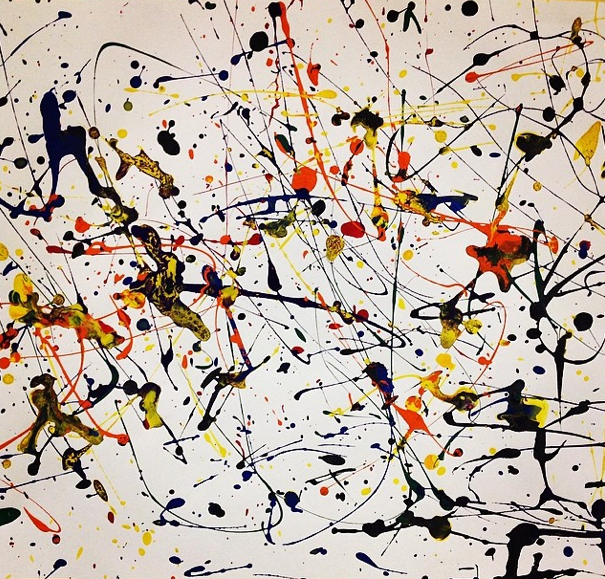
Kindergarten students learned about Jackson Pollock and his painting technique.  After setting up our paints and brushes in the room, the students began drip/splatter painting.  They thought about how they were feeling at the time.  Many students also related particular colors to their feelings.  We also focused on the movement that was necessary to create drip lines.  Here are some student examples:


Digital Drip Paintings

Before the kindergartners created their own drip paintings, we went to Jackson Pollock's website to create digital versions.  Each class collaborated to create one drip painting.  Here are some examples:


Kindergarten - Stuart Davis Collages

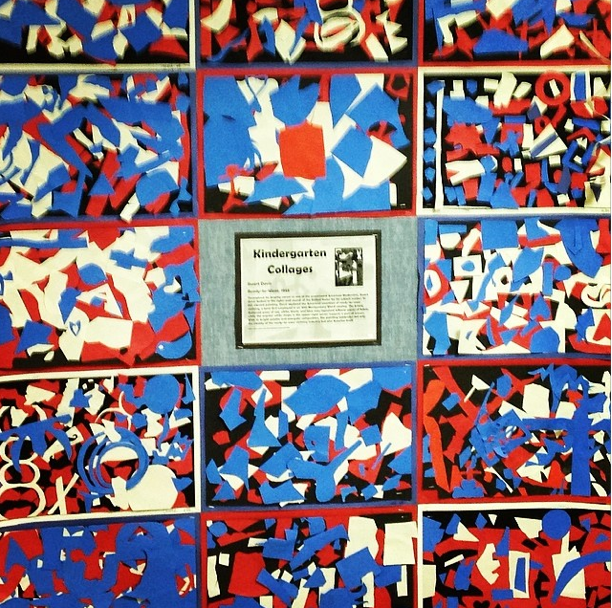
We learned about Stuart Davis and how he was an early American Modernist painter. He created proto-pop art paintings that were colorful and influenced by jazz music. The students noticed that he used geometric and organic shapes in many of his paintings. We then focused a little bit more on his painting "Ready-to-Wear" (1955).
"Throughout his lengthy career as one of the preeminent American Modernists, Stuart Davis looked to the sights and sounds of the United States for his subject matter. In this vibrant painting, Davis explored the American invention of ready-to-wear clothing, a term first employed in an 1895 Montgomery Ward catalog. The broad, flattened areas of red, white, black, and blue may represent leftover pieces of fabric, while the angular white shape in the upper-right corner suggests a pair of scissors. With its bright palette and energetic composition, the painting celebrates not only the vitality of the ready-to-wear clothing industry but also America itself."
Kindergarten students worked on black construction paper and cut our a variety of shapes from red, white, and blue construction paper. We made sure that we used organic and geometric. We also made sure that we were overlapping the shapes.
Here are some kindergarten examples below:


Thursday, January 30, 2014

Kindergarten - Klee Fish

We began this project by reading a book on the artist Paul Klee.  After learning about Klee and the style of his work, we observed the painting "The Goldfish".  We noticed how the colors contrast each other because of the dark, black water and the bright, bold colors of the fish.  The students began with pencil by drawing all sorts of underwater sea creatures and plants.  Once their drawings were completed, they used oil pastels to color them in.  Lastly, a black wash was used over the pastels to create a dark background.  We learned how water resists the oil pastel and slides right off!


Kindergarten - Cave Paintings

Recently our kindergarten students went on a virtual tour through the Lascaux caves.  The paintings in the original caves date back over 17,000 years!!!  We began our project by making our paper look like the cave walls.  We took a white sheet and crumpled it into a ball.  The paper ball was opened and then flattened on the table.  We then used a black crayon to rub over the paper which enhanced the textures created by the crumpling.  The students then used a brown wash to cover the entire sheet.
History
In September 1940, the entrance to Lascaux Cave was discovered by 18-year-old Marcel Ravidat. Ravidat returned to the scene with three comrades, Jacques Marsal, Georges Agnel, and Simon Coencas, and entered the cave via a long shaft. The four teenagers discovered that the cave walls were covered with depictions of animals.  The cave complex was opened to the public in 1948.  By 1955, the carbon dioxide produced by 1,200 visitors per day had visibly damaged the paintings. The cave was closed to the public in 1963 in order to preserve the art. After the cave was closed, the paintings were restored to their original state, and were monitored on a daily basis. Rooms in the cave include The Hall of the Bulls, the Passageway, the Shaft, the Nave, the Apse, and the Chamber of Felines.

Since 1998 the cave has been beset with a fungus, variously blamed on a new air conditioning system that was installed in the caves, the use of high-powered lights, and the presence of too many visitors.
  As of 2008, the cave contained black mold which scientists were and still are trying to keep away from the paintings. In January 2008, authorities closed the cave for three months even to scientists and preservationists. A single individual was allowed to enter the cave for 20 minutes once a week to monitor climatic conditions. Now only a few scientific experts are allowed to work inside the cave and just for a few days a month but the efforts to remove the mold have taken a toll, leaving dark patches and damaging the pigments on the walls.

Lascaux II, a replica of two of the cave halls (the Great Hall of the Bulls and the Painted Gallery) was opened in 1983, 200 meters from the original.  Reproductions of other Lascaux artwork can be seen at the Centre of Prehistoric Art at Le Thot, France.

To take the tour, click the image below.


After learning all about Lascaux, the kindergarten students created their own cave paintings.  We crumpled and painted our plain white paper to look like cave walls.  The students then painted animals and human figures on their cave walls.  Each student had a story behind their painting as well.  Great job kindergartners!

Kindergarten - Flying Saucers

Before winter break, the kindergartners were learning about space and the moon.  In art we read the book, "Dogs In Space" and then began our own outer space artwork.  We used simple shapes and lines to create our own flying sauces.  The students then chose what would be flying that saucer (animal, alien, human, etc.)  Once the students were finished with their pencil drawings, they used a variety of tempera paints to finish their work.  Great job!


Friday, November 8, 2013

Pinch Pots & Shoe Pendants

This week the kindergartners began making pinch pots.   We discussed the history of pinch pots, where clay comes from, differences in clay, and the stages of clay.  From there I demonstrated how to create a pinch pot.  The students had a blast creating their pinch pots!  Some of the students also created "shoe pendants" if they had additional time.  The shoe pendant is formed from a small ball of clay pressed onto the bottom of a shoe.  The end result is a cool texture and pattern that can be used as a pendant.  Kindergartners used low fire gloss glazes to finish their pieces.


Pumpkin Faces

The kindergartners reinforced their knowledge of face making and 3-Dimensional objects when creating their pumpkin faces.  We discussed how to use lines to make our flat paper appear round.  We also discussed how facial features help show a person's emotion.  We came to the conclusion that the only facial feature that did not affect an emotion was the nose.  The students cut their facial features out of construction paper and also used oil pastels to add additional details.


Line Sculptures

The kindergartners were introduced to sculptures recently.  We observed many examples via a PowerPoint presentation.  We compared the differences between  2-Dimensional and 3-Dimensional objects.  Some of the sculptures we looked at were realistic, while others were more modern and abstract.  The students loved seeing all the differences in size, color, and textures.  For our project we used strips of construction paper to make wavy sculpture lines.  We imagined that we were making a roller coaster, water park, race track, etc.  We discussed many ways that the paper could be manipulated to create a 3-Dimensional line. 


Picasso Faces

After learning about Picasso and creating a class Picasso face, the kindergartners used different colored construction paper to create their own individual Picasso face.  We discussed how different shapes, colors, and lines would help make our faces unique.  The students placed the facial features wherever they desired.  They had a lot of fun making these!


Thursday, October 10, 2013

PicassoHead.com

Our kindergartners read Picasso (Getting to Know the World's Greatest Artists) last week in class.  We learned that Picasso was very innovative and changed his painting style numerous times throughout his life.  We learned that he went through certain periods, such as the Blue and Rose periods, and how he also created cubism.  After we read our book, we visited the website PicassoHead.  Each student helped add a feature or change a color of a feature to create their classroom Picasso head.  Notice how the eyes, nose, mouth, and ears are not exactly in the correct spots!


Sunday, October 6, 2013

Mouse Paint

This project was inspired by Ellen Stoll Walsh's book "Mouse Paint". The story is about three white mice who wind up covering themselves in the primary colors. The mice discover that they can make three new colors by mixing two of the primary colors together. Those three new colors are the secondary colors. The kindergartners used pencils to draw out a mouse and two puddles. The next art class the students choose a secondary color that their mouse would be (Orange, Green, or Violet). They painted in their puddles first with the corresponding primary colors. Once the puddles were painted, the students mixed their two primaries and created their secondary color to paint their mouse with. Once their mouse was completely painted, the students chose a color to paint the wall behind the mouse. We finished the project by touching up our lines with permanent marker.


Mondrian Compositions

Kindergarten students observed work created by Piet Mondrian, as well as artwork that has been inspired by Mondrian's work.  We looked at "Composition II in Red, Blue, and Yellow" and observed how the composition only used vertical and horizontal lines.  We also discussed how he only used three colors, which are the primary colors.  The students then created a Mondrian like composition by gluing down vertical and horizontal lines.  The students then chose one section to paint in red, one section to paint in yellow, and one section to paint in blue.

Line Designs

Kindergartners began class by learning about three very important lines: vertical, diagonal, and horizontal.  While those three are very important, we know that there are many more lines that can be created.  As a class we began brainstorming a variety of creative lines.  We discussed wavy, zig-zag, dotted, patterned, thick, thin, etc!  The students then drew out numerous lines on a sheet of 12 x 18" paper.  The end result gave us a unique piece of artwork created entirely by lines.