Showing posts with label Art History. Show all posts

Monday, March 18, 2013

1st Grade -- #Adinkra Symbols

1st graders learned about adinkra symbols created by the Akan people of Ghana in West Africa. Adinkra symbols are visually symbols that represent concepts or aphorisms. "The symbols have a decorative function but also represent objects that encapsulate evocative messages that convey traditional wisdom, aspects of life, or the environment. There are many different symbols with distinct meanings, often linked with proverbs." We watched a few video clips that demonstrated the dye being created, the symbols being created, and the printing of the symbols on fabric.
The first graders then created their own adinkra cloth with the use of yellow, green, red, and black construction paper. They used adinkra sponges to print their symbols and also drew out ones that wanted represented in their cloth. We used red, yellow, green, and black because those are the colors found in the Ghana flag.
Here is an example of one in progress:


Here are some more examples of the adinkra process:


Kindergarten -- Pollock Paintings

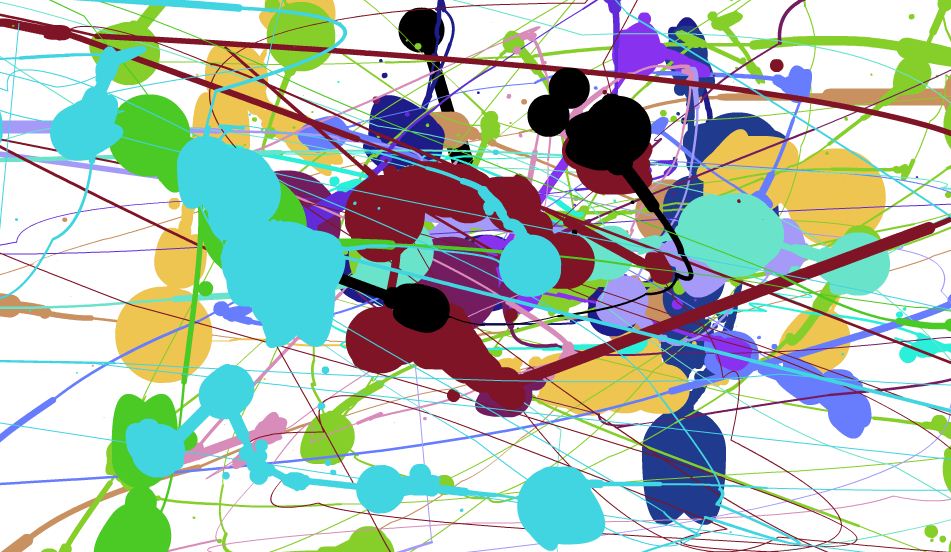
Kindergarten students learned about Jackson Pollock and his painting technique.  After setting up our paints and brushes in the room, the students began drip/splatter painting.  They thought about how they were feeling at the time.  Many students also related particular colors to their feelings. 


Friday, March 1, 2013

1st Grade -- #Heart Paintings

Jim Dine is closely associated with the development of Pop Art in the early 1960's.  Mr.  Kaegi's class focused on Jim Dine's series of heart paintings.  We observed numerous paintings and discussed how he used color, line, texture, and balance.  Those principles and elements were then applied to our paintings.  Great job first graders!


5th Grade -- #Tessellations

5th grade students learned about M.C. Escher and his tessellation work. We started our project by creating an equilateral triangle. Side one and side two of the triangle used the same design, so that both sides could fit into each other. Side three was divided into halves, so that it could fit into itself. Once the students had a final shape that could tessellate, they imagined what it looked like. Their design was incorporated into every shape that was traced out. The students finished the artwork by coloring in their shapes with markers.  Here are some examples from Ms. Germanier's class:


Wednesday, February 27, 2013

KSe & KJ -- Digital Drip Paintings

Yesterday in art, Ms. Serio's and Mr. Jerkatis' classes learned about Jackson Pollock and his technique of painting.  We then created a class digital drip painting via jacksonpollock.org.
In our next class, we will all make our own action paintings with tempera paint!
(KSe painting on top, KJ painting on bottom)


Tuesday, February 26, 2013

Kindergarten -- Cave Paintings

After learning all about Lascaux, the kindergarten students created their own cave paintings.  We crumpled and painted our plain white paper to look like cave walls.  The students then painted animals and human figures on their cave walls.  Each student had a story behind their painting as well.  Great job kindergartners!


Monday, February 25, 2013

Ms. Beljung's Class -- Digital Drip Painting

Today in art, Ms. Beljung's class learned about Jackson Pollock and his technique of painting.  We then created a class digital drip painting via jacksonpollock.org.
In our next class, we will all make our own action paintings with tempera paint!

Friday, February 22, 2013

Ms. Smith's Class -- Digital Drip Painting

Today in art, Ms. Smith's class learned about Jackson Pollock and his technique of painting.  We then created a class digital drip painting via jacksonpollock.org.
In our next class, we will all make our own action paintings with tempera paint!


Tuesday, February 5, 2013

2nd Grade -- Blue Dogs

This art project was inspired by the artist George Rodrigue.  Rodrigue has been painting Blue Dog since 1984.  Blue Dog is a creation inspired from Rodrigue's dog Tiffany and a Louisiana legend called loupe garou (werewolf).  The students viewed many examples of Blue Dog via a PowerPoint slideshow then proceeded to create their own version.
Check out some examples below!


Kindergartners visit Lascaux

Today our kindergarten students went on a virtual tour through the Lascaux caves.  The paintings in the original caves date back over 17,000 years!!!  We began our project by making our paper look like the cave walls.  We took a white sheet and crumpled it into a ball.  The paper ball was opened and then flattened on the table.  We then used a black crayon to rub over the paper which enhanced the textures created by the crumpling.  The students then used a brown wash to cover the entire sheet.  During our next art class, the kindergartners will add paintings to their cave walls!

In September 1940, the entrance to Lascaux Cave was discovered by 18-year-old Marcel Ravidat. Ravidat returned to the scene with three comrades, Jacques Marsal, Georges Agnel, and Simon Coencas, and entered the cave via a long shaft. The four teenagers discovered that the cave walls were covered with depictions of animals.  The cave complex was opened to the public in 1948.  By 1955, the carbon dioxide produced by 1,200 visitors per day had visibly damaged the paintings. The cave was closed to the public in 1963 in order to preserve the art. After the cave was closed, the paintings were restored to their original state, and were monitored on a daily basis. Rooms in the cave include The Hall of the Bulls, the Passageway, the Shaft, the Nave, the Apse, and the Chamber of Felines.

Since 1998 the cave has been beset with a fungus, variously blamed on a new air conditioning system that was installed in the caves, the use of high-powered lights, and the presence of too many visitors.
  As of 2008, the cave contained black mold which scientists were and still are trying to keep away from the paintings. In January 2008, authorities closed the cave for three months even to scientists and preservationists. A single individual was allowed to enter the cave for 20 minutes once a week to monitor climatic conditions. Now only a few scientific experts are allowed to work inside the cave and just for a few days a month but the efforts to remove the mold have taken a toll, leaving dark patches and damaging the pigments on the walls.

Lascaux II, a replica of two of the cave halls (the Great Hall of the Bulls and the Painted Gallery) was opened in 1983, 200 meters from the original.  Reproductions of other Lascaux artwork can be seen at the Centre of Prehistoric Art at Le Thot, France.

To take the tour, click the image below.


Tuesday, January 29, 2013

Kindergarten -- Pinch Pots

The pinch pot is a simple form of a pot that dates back to ancient history. These decorative/functional pots have been used by various cultures throughout history as well. Our kindergarten students learned how to create a pinch pot. Once bisque fired, the students also learned about glazes and how to use them. Here are some finished examples:


Friday, January 18, 2013

Kindergarten -- Stuart Davis Collages

We learned about Stuart Davis and how he was an early American Modernist painter. He created proto-pop art paintings that were colorful and influenced by jazz music. The students noticed that he used geometric and organic shapes in many of his paintings. We then focused a little bit more on his painting "Ready-to-Wear" (1955).
"Throughout his lengthy career as one of the preeminent American Modernists, Stuart Davis looked to the sights and sounds of the United States for his subject matter. In this vibrant painting, Davis explored the American invention of ready-to-wear clothing, a term first employed in an 1895 Montgomery Ward catalog. The broad, flattened areas of red, white, black, and blue may represent leftover pieces of fabric, while the angular white shape in the upper-right corner suggests a pair of scissors. With its bright palette and energetic composition, the painting celebrates not only the vitality of the ready-to-wear clothing industry but also America itself."
Kindergarten students worked on black construction paper and cut our a variety of shapes from red, white, and blue construction paper. We made sure that we used organic and geometric. We also made sure that we were overlapping the shapes.
Here are some kindergarten examples below:


4th Grade -- Clay House Fronts

For this project we examined architecture by Frank Lloyd Wright and Friedensreich Hundertwasser.  Frank Lloyd Wright used geometric shapes and organic colors in his architecture, while Hundertwasser used many bold colors, curvy lines, and organic shapes.  Both architects loved to incorporate the surrounding environment with their architecture.  Our 4th grade students sketched out a design for their own house.  Some students were inspired by TV shows, by famous architects, or even their own home in Oak Park.  The students rolled out slabs of clay, trimmed out the shape of their house, and then began designing it.  They scored and slipped whenever they attached additional pieces.  They used modeling tools to carve in designs as well.  Once the pieces were bisque fired, the students then used glaze to finish their houses.


Tuesday, December 11, 2012

Kindergarten -- Klee Fish

We began this project by reading a book on Paul Klee.  After learning about Klee and the style of his work, we observed his painting "The Goldfish".  We noticed how the colors really contrast each other because of the dark black water and the bold colors of the fish.  We started brainstorming as a class what lives under water..  From there the students drew their underwater scene and used oil pastels to color in their objects.  We used a black wash over the paper to fill in the background.  This allowed us to see how the oil pastels resist water. 


2nd Grade -- Family Portraits

2nd graders learned about Carmen Lomas Garza and observed many of her family portraits.  With so many examples to look at, we were able to get a better understanding of Carmen's family.  The students noticed how family members interacted with each other, how pets can be considered part of the family, and how we experience good and bad moments throughout life.  The students then thought of a moment in their lives that really had an impact on them.  We used pencil to begin our drawings on the 18" x 24" paper and also put an emphasis on drawing BIG.  The students then used crayons to color in their portraits.

5th Grade -- Silhouette Self-Portraits

We began this project by viewing many different examples of silhouettes.  We discussed what a silhouette was and how it has been an important part of art for hundreds of years.  Kara Walker is a current artist who uses silhouettes in her artwork.  The students created lists or webs to help generate things that described them as an individual.  We were focusing more on those qualities and not our outside appearance for this self-portrait.  With the use of the projector, I was able to trace out the students' silhouettes onto 18" x 24" white drawing paper.  From there the students filled up their silhouettes with ideas that described them.  We tried to draw only visual images and to avoid writing with words.  The students then used permanent markers to go over their pencil lines.  This helped add contrast to their silhouette.  They cleaned out the remaining pencil with erasers, cut out their silhouette, and then glued it to black paper.


Monday, December 10, 2012

3rd Grade -- Tessellations

For this project we were linking art together with math to create M.C. Escher like tessellations.  Tessellation is the process of creating a two-dimensional plane using the repetition of a geometric shape with no overlaps or gaps.  The students began with a 3" x 3" square.  They created a line design on the left side with pencil.  That piece was cut out and taped to the right side of the square.  This process was repeated on the top and bottom of the square as well.  The end result was a shape that could fit into itself from side-to-side and top-to-bottom.  Third graders envisioned what their shaped looked like and then drew their creation into their shape.  They used a color pattern to finish their work.


1st Grade -- Space Invaders

The first grade students observed a current street artist with the alias "Invader".  We discussed how street art can have both positive and negative aspects to it.  "Invader" creates mosaic tiles and attaches them to buildings throughout the world.  He also creates mosaics from Rubik's cubes.  Mr. Kaegi's class created their own space invaders out of paper tiles that were 1" x 1".  Great job guys!


Tuesday, November 6, 2012

5th Grade Notan Designs

Notan is a Japanese design concept involving the play and placement of light and dark as they are placed next to the other in art and imagery. We viewed many examples of artists who have created Notan designs. After discussing the process to create the notan design, the 5th grade students drew a design in their sketchbooks. From there they choose a colored square, cut out all of their designs, and created the positive and negative placements.


3rd Grade Paper Mosaics

A mosaic is the art of creating images with an assemblage of small pieces of colored glass, stone, or other materials. It may be a technique of decorative art, an aspect of interior decoration, or of cultural and spiritual significance as in a cathedral. Small pieces, normally roughly quadratic, of stone or glass of different colors are used to create a pattern or picture. As a class we looked observed a PowerPoint with many ancient mosaic examples. From there, we looked at more modern examples such as space invaders created by street artist "Invader". The students planned an image in their sketchbooks at first, then followed out their plan by creating a paper mosaic. Most created small square tiles with the use of a pencil and ruler. The paper tiles were attached with white glue.